

Between January and June, 328,208 home sales were recorded, levels not seen since 2008. In fact, the 163,909 sales registered in the second quarter of this year alone represent the second-best result since the beginning of 2008, only behind 164,299 in the first quarter of 2022, according to the Real Estate Registry Statistics of the College of Property Registrars, which collects quarterly data.
One of the reasons why more houses are being transacted than ever since the last real estate boom is the marked interest of foreign buyers in acquiring a house in Spain.
Since the registrars take data on the nationality of home buyers, the maximum levels had been above 13%, without reaching the levels reached in this last quarter. “It represents a notable increase in foreign demand in a particularly intense market since the end of the pandemic,” the registrars affirm.
Only at the end of 2015 it reached 14.38%, but in another economic context in which barely 84,000 homes were sold between October and December of that year.
And it is that, since the third quarter of 2021, when the entry of foreign citizens to our country was normalized after the end of the strict measures to control access to the country due to the pandemic, the purchase of houses by foreigners once again reached pre-pandemic figures. As of July 2021, transactions have not fallen below 16,000 sales in the following four quarters.
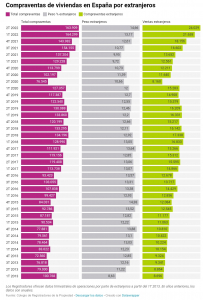
In the two quarters of 2022, operations by foreigners have exceeded 20,000 transactions, absolute numbers that have never been recorded before. Between January and March they acquired 21,638 houses, while between April and June they exceeded it with 24,029 home sales. “Without a doubt, this is a segment with a significant upward trend, which is helping to achieve especially relevant figures in residential real estate activity”, the registrars point out in their report.
The average of these last four quarters is 20,106 signatures, while in the previous four quarters (Q3 2020-Q2 2021), the average was 12,516 operations. In 2018, the record year for home sales by foreigners in Spain with more than 65,500 operations, the average was close to 16,380 transactions per quarter.
“The favourable evolution of foreign demand is verified by verifying how the percentage of purchases by foreigners accumulates a new quarter of growth, being especially relevant in a period with a high number of home sales in absolute terms”, add the registrars.
Where do they buy and what houses do the British, German or French prefer?
The data on the sale of houses by foreigners confirm a trend, since the return to normality after the pandemic, in a much more equitable proportion in the distribution of total operations.
The nationalities that bought the most houses in Spain between last April and June were British (9,8%, 2.310), the second lowest figure since data is available, followed by Germans(9,1%, 2.140), French(6,6%, 1.560), Moroccans (4,9%, 1.160), Belgians(4,9%, 1.155), Romanians(4,8%, 1.150), Dutch(4,8%, 1.130) e Italians(4,6%, 1.080). This situation is noticeable, above all, in the British, who have always been the main buyers of houses in our country, reaching levels above 20% in 2015, although on average they have exceeded 12.5%. But since the end of 2020, three quarters have already been recorded where they do not exceed 10% of the total operations among foreign buyers.
“Observing the graphs of the evolution of the interannual results in the number of purchases for these nationalities, it can be seen how practically all of them, except the British, are at maximum levels in recent years,” the registrars point out in their report.

A situation confirmed at the foot of the field (as it would be said in sports jargon) by the agents of the housing sector in Spain. “Regardless of the rebound effect due to the dammed-up demand during the covid years, we are seeing more and more buyers in Spain seek to take advantage of longer seasons or stays and telecommute,” says Alfredo Millá, CEO of Sonneil. «This is a new and very promising phenomenon for the second home market in Spain and, if it consolidates and generates a drag effect, it can greatly increase the volume of buyers. We must remain vigilant », he states.
Some effects after the pandemic confirmed by Marc Pritchard, Director of Sales and Marketing of Taylor Wimpey Spain. “Housing has gained importance in the post-Covid era, with the increase in teleworking. But it has also become a refuge value as an investment in the face of stock market volatility and low interest rates in banks. The energy effect must also be taken into account, since energy costs are cheaper in Spain than in other countries, and heating is necessary for more months in the rest of Europe”.
Other outstanding factors that the experts see and that are the ones that have always attracted foreign buyers, such as “the climate, air connectivity or the cost of living”, according to Mario Garnica, director of Engel & Völkers Málaga, who for the own capital of the Costa del Sol, and can be transferred to other coastal cities, adding “its cosmopolitan character or the technological business ecosystem, among others”, he specifies.
Alicante, Malaga and both archipelagos follow the areas where foreigners have a greater weight in the housing market. Alicante’s Costa Blanca continues to lead (42.2%), accompanied by the Canary province of Santa Cruz de Tenerife (38.3%), the Balearic Islands (34.6%), Malaga (32.8%) and the other insular province of Las Palmas (26.6%). Girona (26.3%) and Almería (20.2%) are other provinces where the weight of foreigners in the purchase of houses is notable.
“The Costa Blanca is usually one of the preferred ones due to the cheapest prices, while the Costa del Sol has the largest volume of homes for sale,” they comment from Taylor Wimpey Spain. “The most demanded housing is usually between two and three-bedroom apartments and three-bedroom semi-detached houses, with a terrace, swimming pool and community garden, in tourist areas. But with the requirement of being either near the beach or near a golf course, and that they mainly serve as a second home”, specifies Marc Pritchard.
For a more urban profile, from Engel & Völkers Málaga they comment that “the most repeated profile is that of a buyer between 45 and 60 years of multiple nationalities, coming from Germany, France, Holland, Belgium, USA or Mexico, and who is looking for a apartment in the historic center, in the coastal area or a villa. The average budget is around 850,000 euros”.
Forecasts to return to pre-covid values in 2023
Experts predict that these maximum figures will slow down due to the delay in the purchase decision due to the current economic context of uncertainty, with inflation still high in many countries around us, the increase in interest rates both in the EU, as in the United Kingdom or the United States, and the economic consequences of the war in Ukraine.
The Director of Sales and Marketing of Taylor Wimpey Spain affirms that 2023 will be the year of return to normality, with values similar to the pre-Covid years, after an atypical three-year period (2020-2022).
From Sonneil they believe that the outlook for new construction will be more encouraging than for second-hand, since it will not be hardly affected by the slowdown that is expected in the rest of the sector. “Newly built residences offer added value that places them above second-hand ones. They are houses built with criteria of sustainability and energy efficiency, with durable materials and qualities and that, in addition, respond to the new demands of buyers, with spaces for teleworking and enjoying the outdoors”, specifies the CEO of the Spanish proptech .
For Mario Garnica, Malaga will continue to be the objective of foreign investors, especially from the US, given the current strength of the dollar against the euro, while teleworking is consolidated and the good quality of life in Spanish cities is confirmed.
Source: idealista.com